Love2D Game Setup
I went to a coffee shop and started learning Lua/Love2D.

This past week, one of my friends was in town visiting family. On Friday, we met up at a coffee shop to co-work. He was doing work work. I decided it was a good time to setup my environment for Love2D game development.
Well, it would be on my laptop, which I use on average twice a year. But if I can set it up once, I can set it up again (at least that is the hope).
We were originally going to meet at this Vietnamese coffee shop that has various coffee flavors like ube, pandan, corn, and even durian. Interesting. I come from a durian-eating family, but I don't think I need it in my coffee.
But alas, the coffee shop was absolutely packed. We picked a different one, which fortunately had open tables and was very spacious.
To setup my environment, I installed Love2D and followed the Sheepolution's Visual Studio Code tutorial. I ended up using the LOVE-VSCode-Game-Template which did most of the work. The biggest hurdle I had was getting the debug/release and build tasks to work. The tasks either weren't showing up, or would complain about the root directory. The issue was that I opened the project as a folder in VSCode instead of opening the VSCode workspace.
Then I moved onto Sheepolution's main tutorial. I rendered a box, made it move around by itself, made it move based on keyboard interaction, and made it move based on mouse interaction (since this is what I will need for my game).
Finally, I created a "button" with centered text that changes based on mouse click.
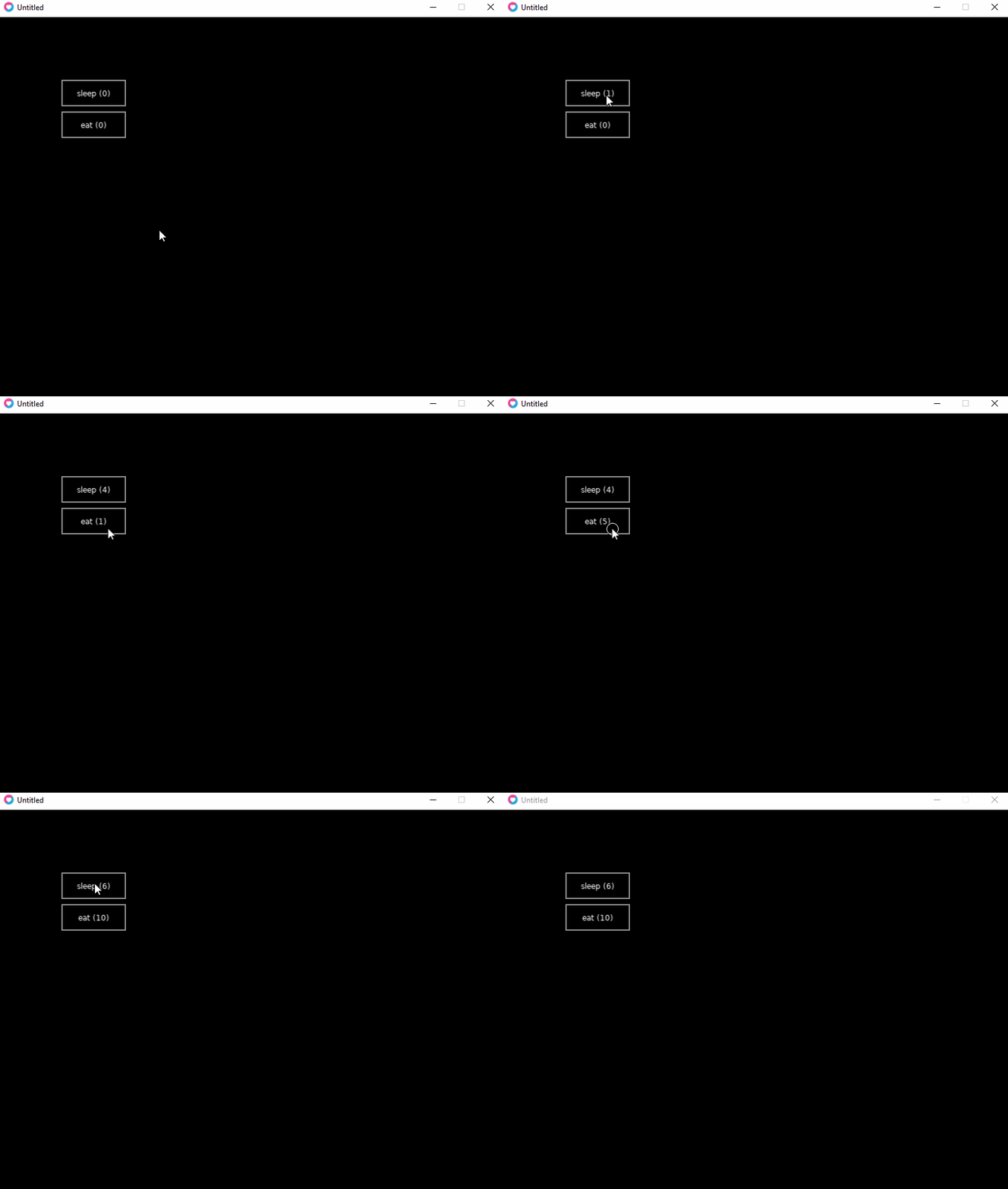
All while learning Lua. (I guess the theme of my sabbatical coding projects is learning new languages.) Lua is also funky. But right now I like it better than Python.
I also have concluded my "market research" of playing Capybara Go. It became tedious and burdensome (new game modes and "events" designed to make you click on a bunch of stuff and waste your time), which is exactly what I don't want my game to be. There are things I liked about it like the cute graphics and the simple game mechanics in story mode. All you do is click a big button to progress, it auto-battles when you encounter enemies, and once in a while you choose new skills or make decisions about penalties and rewards. My game will not be like that, but I enjoyed the simplicity. What I didn't enjoy was having to commit to a whole "session" in some of the game modes. It could take 5-10 minutes, or even more. Which by itself isn't bad. But when there's multiple game modes and dailies and a sense of pressure to do all the things and FOMO, it became a major time sink. I was spending multiple hours playing it every day, when I definitely had better things to do. Friday was probably the first day I didn't play it much because I was out of the house, and I didn't feel like I was missing out on anything.
So in the end, this was just a reminder of what kind of game I truly enjoy and want to make.
A game that has an end. I imagine I'll be "releasing" the story of my game incrementally, so initially there will be content updates, but they will be like chapters in a story.
A game that respects your time. If you want to sit there and play the whole thing in one sitting, you can. There should be no artificial time restrictions to prevent you from doing so (i.e. no waiting for energy to restore that isn't a meaningful game mechanic). The game can always progress as long as you made the right decisions. On the other end of the spectrum, if you want to play in short, segmented sessions, you also can. There should be no dependency on real-time; any time mechanic is in-game only. There may be a bit of idling to accumulate resources, but there should always be something you can progress to that makes the idling unnecessary.
This reminds me of why I couldn't get into Cozy Grove. (I say I couldn't get into it but apparently I have 35 hours of play time on it. I really tried to like it.) I saw it recommended after I finished Spiritfarer. It had a similar theme of helping spirits, but that was the only similarity. It was really just a game with dailies to do. Sure, in both games you can do stuff like fishing and collecting sticks and stuff, but in Spiritfarer, there was no limit. You could always travel to a different island and collect resources there. In Cozy Grove, the resources would run out for the day. There was always a point in each session that there was no more progress that could be made. I had to stop and wait for the next day for new quests. At the very least, it didn't have the crazy amount of "daily content" to attend to like Capybara Go has.
A game should not imply that I need to stop playing. It should also not get me so addicted that I cannot stop, but not because I'm actually having a good time.
As far as what I want to accomplish next, I want to make a simplified clone of an existing game to get more experience in Lua/Love2D and build some sort of framework that my actual game can use. So I should pick a game that is somewhat similar. I am considering a clone of just the story mode of Capybara Go. But I will think if there's other games that are better candidates. I don't expect to continue work on this until I finish my todo list notifications though. I don't want to give myself even more decision paralysis about what to work on each day. Because I already have plenty of that!